May 19, 2026
Beer Line Cleaner Chemical: What Is in the Bottle and Why It Matters for Your Draft System
Here is what is inside your beer line cleaner chemical and why choosing wrong costs you.
Beer Line Cleaner Chemical: What Is in the Bottle and Why It Matters for Your Draft System
Most bar and restaurant operators use a line cleaning product on a schedule and assume the job is getting done. What very few know is whether the chemical they are using is actually right for their system, their water, or what is living in their lines.
Choosing the correct beer line cleaner chemical is not a matter of grabbing whatever the distributor dropped off. Different chemicals target different types of buildup, work at different pH levels, and require specific handling to be effective and safe. Using the wrong one, or using the right one incorrectly, means your lines are not as clean as you think they are, and your beer is paying the price.
If you manage a draft beer system and have never thought past "we clean every two weeks," this is worth reading carefully.
Why the Chemistry Behind Line Cleaning Actually Matters
Beer leaves behind four main categories of residue inside draft lines. Proteins from malt, yeast cells and yeast byproducts, hop resins, and mineral deposits from water and CO2 interaction. No single chemical type addresses all four equally well. A cleaning product that handles organic buildup efficiently may do very little against mineral scale, and vice versa.
Operators who rely on one product for every cleaning cycle are almost certainly leaving one category of buildup behind. Over time, that accumulates. Flavor contamination compounds, biofilm thickens, and beer stone hardens into deposits that become significantly more difficult to remove the longer they sit. Getting the chemistry right from the start protects both pour quality and the long-term condition of your lines and fittings.
A line that looks clean after a caustic flush may still have beer stone buildup that only an acid cleaner will remove. Clean-looking is not the same as actually clean.
The Two Main Types of Beer Line Cleaner Chemical
Every effective line cleaning program is built around two chemical categories. Understanding what each one does, and when to use it, is the difference between a protocol that actually works and one that creates the appearance of maintenance without delivering the results.
Alkaline and Caustic Cleaners
Alkaline cleaners are the workhorse of most two-week cleaning cycles. Products in this category are typically sodium hydroxide or potassium hydroxide based, with a high pH that breaks down organic material at a chemical level. Proteins, yeast residue, and biological film all respond to alkaline solution. The higher the pH, the more aggressive the action on organic deposits.
Most standard beer line cleaning products available through draft supply distributors fall into this category. They work well for routine organic buildup when used at the correct concentration and allowed adequate contact time. Diluted too far or flushed through too quickly, they lose most of their effectiveness and give operators a false sense that the lines are clean.
Acid Cleaners
Acid cleaners handle what alkaline products cannot. Beer stone, the hard yellowish calcium oxalate scale that forms on the interior walls of lines and faucet components, is mineral-based and largely resistant to caustic solution. Phosphoric acid and peracetic acid are the most common active ingredients in beer line acid cleaners, and they dissolve mineral deposits while also neutralizing any alkaline residue left from the previous cleaning step.
Acid cleaning is not a replacement for caustic cleaning. It is a complement to it. The standard recommendation from the Brewers Association Draft Beer Quality Manual is to run an acid cleaner every four to six weeks alongside the regular caustic cycle. Operations that skip the acid rotation entirely will eventually deal with beer stone accumulation that requires aggressive intervention to clear.
Sanitizers Are Different from Cleaners
A sanitizer is not a cleaner, and the distinction matters. Sanitizers reduce microbial counts on surfaces that have already been cleaned. Running a sanitizer through a line that has not been properly cleaned with a caustic solution first gives you a sanitized layer of organic buildup, which is not an improvement. Sanitizers used after a thorough cleaning cycle provide an added layer of microbial control but should never be used as a substitute for the cleaning step itself.
How Beer Line Cleaner Chemical Concentration Affects Your Results
Concentration is where most in-house cleaning programs fall short. Every chemical product has a manufacturer-specified dilution ratio. That ratio is not a suggestion. It is the concentration at which the product was tested and validated to do what the label claims. Diluting a caustic cleaner further to stretch a bottle further is a common cost-saving move that produces lines that are not actually clean.
Under-concentration is the more common mistake, but over-concentration is its own problem. A caustic solution that is too strong can degrade certain line materials over time and creates a more serious residue risk if the rinse step is not thorough. More product does not mean a better clean. The right amount at the right strength, applied for the right amount of time, is what produces results.
Contact time is the other variable that gets compressed. A caustic soak that sits for eight minutes instead of twenty is not doing the same job. The chemical reaction that breaks down organic deposits requires time to complete. Speeding through the soak step is the fastest way to turn a properly concentrated solution into an ineffective one. If your in-house cleaning program is being run during a busy shift changeover, there is a reasonable chance the soak time is being cut short.
Water Quality and Its Effect on Your Beer Line Cleaner Chemical
Water hardness is a variable that most operators never factor into their line cleaning chemistry, but it has a real impact on results. Hard water, high in calcium and magnesium, reacts with cleaning chemicals in ways that reduce their effectiveness. Alkaline cleaners in hard water environments lose a portion of their cleaning action to the minerals in the water before they ever reach the buildup on your line walls.
Operations in regions with notably hard municipal water may need to adjust their cleaning protocol accordingly. That could mean a higher starting concentration, more frequent acid cycling to address accelerated beer stone formation, or a water softening step before mixing cleaning solution. A professional service provider who understands your local water conditions can factor this into the protocol they run on your system. If your current provider has never mentioned water hardness, that is a gap worth addressing.
The Master Brewers Association of the Americas addresses water chemistry and its interaction with cleaning compounds in their technical resources, which are a useful reference for anyone building or auditing a line cleaning program.
Handling and Safety Considerations for Draft Line Cleaning Chemicals
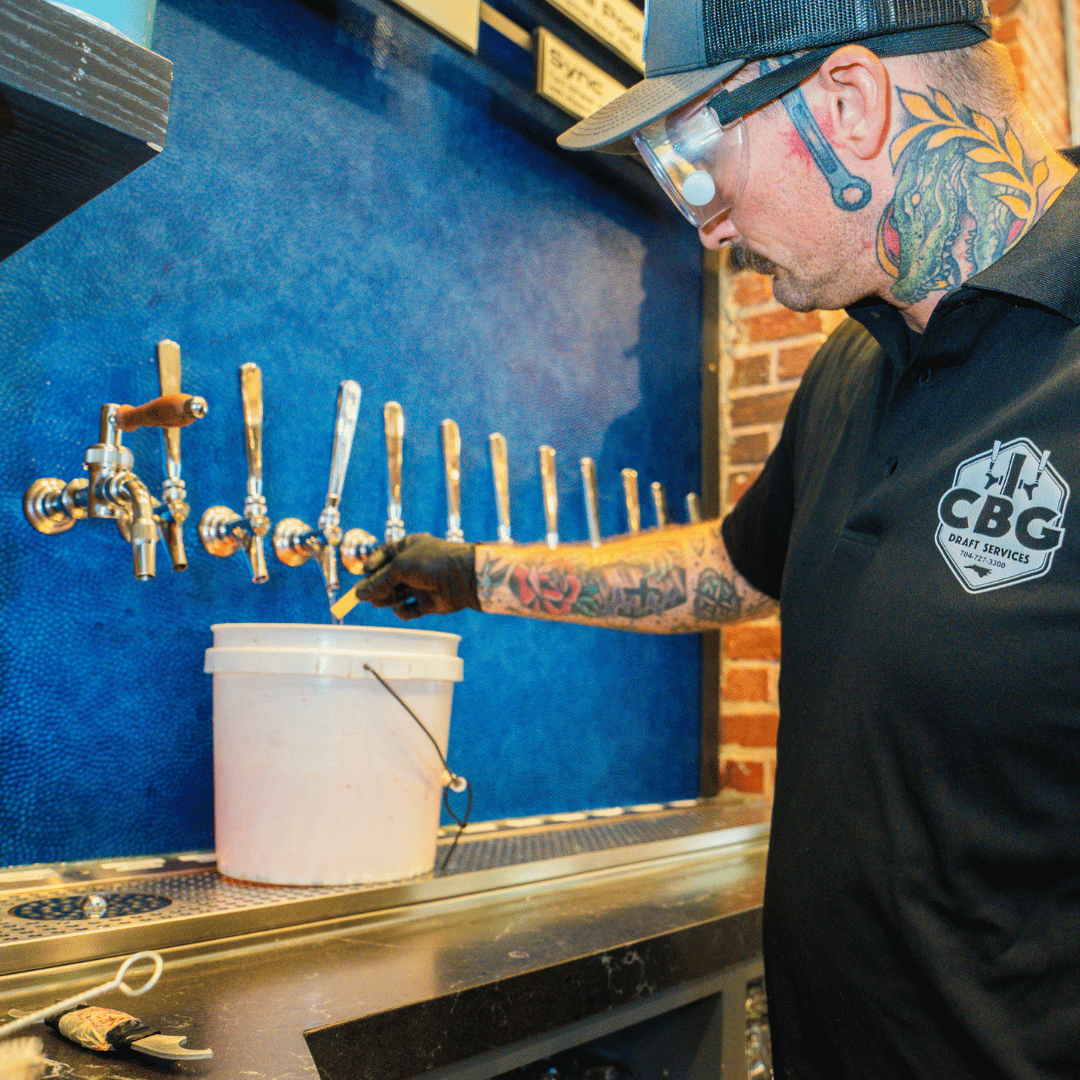
Caustic and acid cleaning products are effective because they are chemically aggressive. Sodium hydroxide solutions can cause serious skin and eye irritation on contact. Acid cleaners at working concentration require the same level of caution. Proper personal protective equipment, including chemical-resistant gloves and eye protection, is not optional when handling these products.
Storage matters as well. Caustic and acid products should never be stored in proximity to each other, since an accidental mix can produce a dangerous reaction. Both should be kept in original labeled containers, stored away from heat, and out of reach in any space where untrained staff might access them without knowing what they are working with.
Residual chemical in a line after an incomplete rinse is also a safety concern, not just a flavor concern. A faucet that still has traces of caustic solution passing through it is a health risk. Every cleaning cycle needs a thorough final rinse, with enough volume to fully clear the line from keg coupler to faucet. Monitoring the rinse water pH before reconnecting kegs is a standard professional practice and one worth adopting in any in-house program. A properly run professional line cleaning service includes this verification step as a baseline, not an extra.
When to Let a Professional Handle Your Beer Line Cleaner Chemical Program
Running a chemical cleaning program correctly is not complicated, but it requires consistency, attention to detail, and staff who understand why each step exists. When any one of those elements is missing, the program produces results that look fine on paper and fall short in the glass.
Operations that have experienced recurring pour quality issues, off-flavors that do not trace back to the keg, or foam problems that persist after gas adjustments are often dealing with a chemical cleaning gap. Sometimes that means the wrong product has been in use. Sometimes it means the right product has been used incorrectly for long enough that the buildup requires a more intensive reset before a standard protocol can maintain the baseline. Either way, a professional assessment of the draft system is the right starting point before investing in more product or more cycles of the same approach.
CBG Draft Services runs professional beer line cleaning programs for bars, restaurants, breweries, and taprooms across North and South Carolina. Every service uses the correct chemical rotation for your specific system, applied at the right concentration and contact time, with a full faucet and coupler service included. If your current protocol is not producing the pour quality your beer deserves, we can assess what needs to change and put a program in place that actually holds up.
Schedule a Line Cleaning Assessment
Or call us at (704) 727-3300 — Mon–Fri, 8am–4:30pm EST